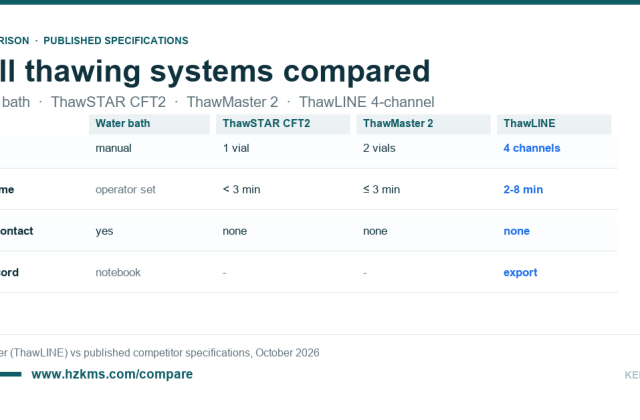
Most comparisons of thawing methods start with speed. Speed is rarely the variable that decides whether this batch is comparable to the last one. The variables that matter are where the temperature is measured, what the sample physically touches, and whether the run leaves a record behind.
Where the temperature is measured
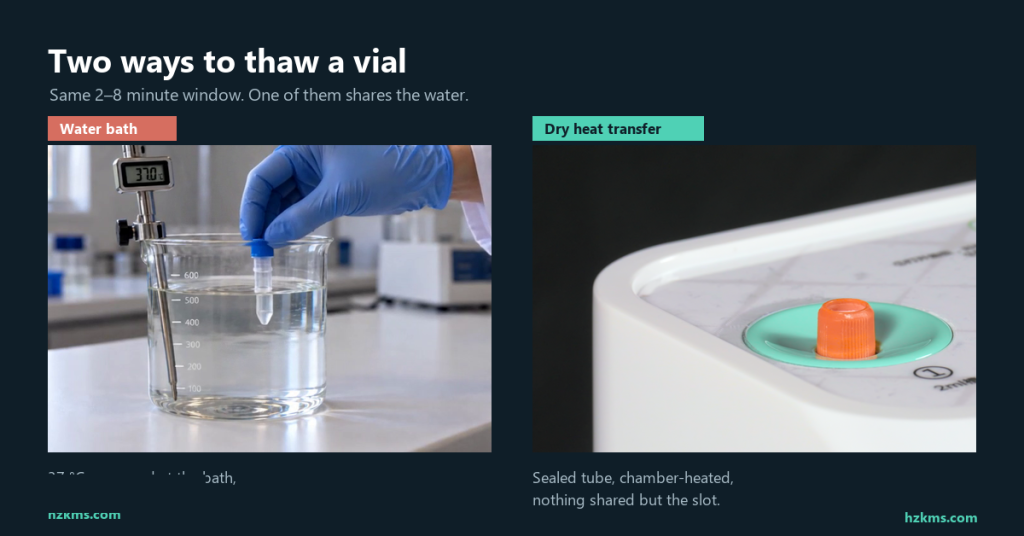
A water bath holds water at 37 °C. It does not hold the contents of your cryovial at any particular trajectory. The outer layer of a 2 ml vial reaches bath temperature long before the core does, and a stopwatch decides when the run ends. Two technicians, same SOP, same bath, will produce two different temperature histories — and neither is written down.
Dry heat transfer does not remove the physics, it removes the medium. The tube stays sealed, the chamber supplies the heat, and contact is metal-to-tube rather than water-to-plastic.

What the sample touches
A bath is a shared vessel. In a busy lab it sees cells, reagents, ungloved hands, a borrowed thermometer, and a top-up of tap water at five in the afternoon. Biofilm forms in corners and along the heating element, and the water is usually changed on a schedule that lives in someone’s head.
In a dry system the sample touches its own tube and the slot. Nothing is shared but the slot, and on our benchtop units a 30-second ozone cycle runs between uses.
15 seconds: bath, dry slot, and the record printed at the end of a run.
What record each method leaves
A notebook entry that says “thawed, 37 °C, ~2 min” is a memory, not a record. It cannot tell you whether the vial reached the target, which bath was used for the contaminated batch, or who was on shift.
An instrumented run can answer those without human reconstruction: start and finish time, calculated duration, input and leave temperature, port or slot, sample identifier, device identity, operator, and an export that cannot be silently edited afterwards.

When a bath is still the right answer
If your work is buffer, reagent and teaching-lab volume, a bath is the correct tool and none of the above applies. If cells are in scope and you keep the bath, three cheap controls move you a long way: change and disinfect the water daily with a signature, use a calibrated thermometer and record the actual reading per batch, and dedicate one bath to cell work.
What those controls cannot do is give you a temperature history for the sample itself. That requires an instrument.
The question worth asking
Not “water or no water”, but “what is the sample touching, and who can prove it was clean” — and, six months later, “can you show me the run”.
Full specifications and container options: products · Questions before you buy: request a quote