Short answer: pick a thawing system by three variables, not by brand — containers per run, container format, and whether QA needs a run record. Single-vial automated devices suit point-of-care and low-volume work; multi-channel dry instruments suit labs running several samples per session; a 37 °C water bath is only defensible where no documentation is required.
Below is a comparison built from published manufacturer specifications only. Where a specification is not published, the table says so instead of guessing — that gap is itself useful, because it tells you what to ask a supplier before you buy.
Comparison table (published specifications, October 2026)
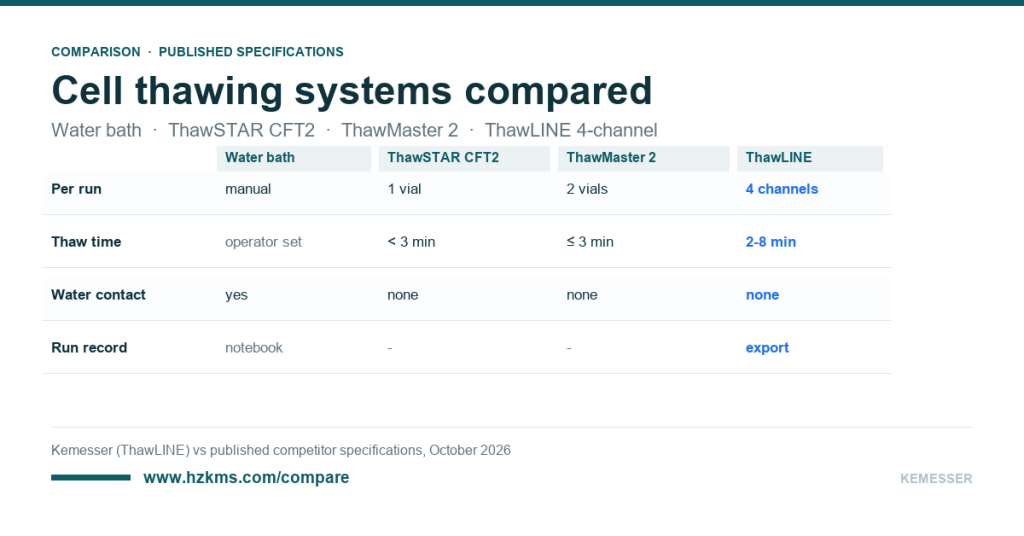
| Attribute | Manual 37 °C water bath | ThawSTAR CFT2 (BioLife) | ThawMaster 2 (Unicorn Lifescience) | ThawLINE (Kemesser) | ThawWaker (Kemesser) |
|---|---|---|---|---|---|
| Container format | Any sealed vial or bag that fits the beaker | 1.8–2.0 ml cryovial (CFT1.5 for 1.5 ml) | 2 ml standard cryovial, fill volume 0.8–1.5 ml | 1.5–5 ml cryotubes; custom ports on request | Cryobags, 30–450 ml |
| Samples per run | As many as fit; each timed by hand | 1 | 2 (each position independently controlled) | 4 independent channels, independent timers | 1 bag per run, four capacity presets |
| Published thaw time | Not specified — set by the operator | Under 3 min | Within 3 min | 2–8 min depending on container | Bag format, per capacity preset |
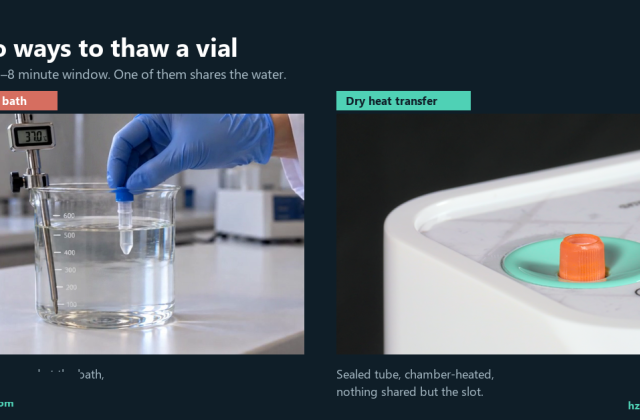
| Water contact | Yes — the sample sits in shared water | No (water-free) | No (water-free) | No (dry, slot-based heat transfer) | No (dry, bag chamber) |
| Run record for QA | Paper notebook, if anyone writes it | Not stated in the published specification | Not stated in the published specification | Exportable run record, SD copy, two-level permissions | Exportable run record, printed thaw report |
| Sanitisation between runs | Change and disinfect the water | Not stated in the published specification | Not stated in the published specification | Ozone cycle, about 30 s | Ozone cycle |
| Footprint / weight | Bench space plus a water source | Compact benchtop, fits in a biosafety cabinet | 230 × 140 × 160 mm, 3.5 kg | See product page for model-specific dimensions | See product page |
| Best fit | Low-value routine work, teaching labs, no audit trail | Point-of-care, one vial at a time, in-cabinet thawing | Early R&D and clinical trial sites, two vials per session | Labs thawing several tubes per session that must show a record | Cell therapy batches frozen in bags rather than vials |
| Watch out for | Contamination events, run-to-run variation, no record | One vial per run; throughput is set by the run queue | Fill volume 0.8–1.5 ml per vial — check your fill | Slot size must match your tube; confirm custom ports early | Bag fittings and fill volume must match the chamber preset |
Sources for competitor columns: ThawSTAR CFT2 specification as published by a European distributor and the CFT2 instructions for use; ThawMaster 2 specification table as published by the manufacturer. Kemesser columns are from our own product pages. Specifications change — confirm with the supplier before ordering.
What the published numbers do not tell you
1. Thaw time is not viability. “Under 3 minutes” describes when the ice is gone, not what survived. Two devices can reach the same end point with very different temperature ramps through the −50 °C to 0 °C window, and that window is where recrystallisation does its damage.
2. Nominal vial size is not your fill volume. ThawMaster 2 is specified for 2 ml vials with a fill volume of 0.8–1.5 ml. If your bank fills 1.8 ml into a 2 ml vial, the thermal load is different from the one the profile was tuned for. Ask any supplier what fill range their profile was validated at.
3. Labels change heat transfer. Thick or unevenly wrapped labels insulate the vial wall. Some manufacturers compensate in firmware; some do not say. This is a fair question to ask in writing.
4. Vendor figures are vendor figures. Where a supplier quotes a viability advantage over a water bath, treat it as a hypothesis to test on your own cells, not as a purchase argument. Independent comparisons exist — for example a published assessment of a water-free automatic device against a water bath in BioProcessing Journal (2026) — and they are worth reading before you commit capital.
Three questions that decide the purchase
- How many containers per session, and can they run in parallel? One vial per run with a 3-minute cycle is fine for a clinic. A lab thawing six doses before a manufacturing slot needs parallel channels, or it will queue.
- Will someone ask you to prove what happened? If the answer is yes — cell therapy release, GMP-adjacent work, a biobank audit — the instrument must produce a run record with time, temperature, port, sample ID and user, exportable without editing. If the answer is no, you are paying for features you will not use.
- What is actually in your freezer? Vials, bags, or both. Bag formats (30–450 ml) and vial formats are different machines; buying for the format you have today and the format you plan to have in two years is the difference between one purchase and two.
How to validate a thawing method on your own cells
Whatever the datasheet says, run this before you scale:
- Split one lot into paired aliquots — same passage, same cryoprotectant, same freeze date.
- Thaw one aliquot per method, same day, same operator.
- Measure: post-thaw viability (AO/PI or trypan blue), total recovered live cells, and 24-hour attachment or growth.
- Repeat at three passages. A single run compares luck, not methods.
- Record the ramp, not just the end time. If the device exports a temperature curve, keep it with the batch record.
Where a water bath is still the right answer
Buffer bottles, reagent thawing, teaching labs, and any workflow where no one will ever ask for a record. A water bath is cheap, fast and universally understood. It stops being defensible when a contamination investigation, a batch deviation or a client audit lands on your desk and the only evidence is someone’s memory.
Sources
- ThawSTAR CFT2 specification and instructions for use — CFT2 manual (PDF); distributor specification summary via Bexen Bioservices
- ThawSTAR white paper — BioLife Solutions (PDF)
- ThawMaster 2 specification table — Unicorn Lifescience
- Published comparison of a water-free automatic device against a water bath — BioProcessing Journal, 2026 (PDF)
- Kemesser ThawLINE and ThawWaker specifications — ThawLINE, ThawWaker
Next step
Tell us three things — container format, containers per session, and whether you need a run record — and we will shortlist the model that fits, or tell you honestly that a water bath is still the cheaper answer for your workflow. If you are comparing against a specific model, send the datasheet and we will put the two specification tables side by side.