A thawing instrument is small, cheap relative to the process it supports, and easy to treat as an accessory. Then an auditor asks who qualified it, and the answer is a purchase order and a manual.
The good news is that a bench-scale thawer does not need a year-long validation programme. It needs three phases with written acceptance criteria, and a record that shows what was actually done.
What each phase is for
| Phase | Question it answers | Typical duration |
|---|---|---|
| IQ — installation | Is this the right unit, installed correctly, with the right documents? | 2–4 hours |
| OQ — operation | Does every function work within its stated range, including the refusal conditions? | 1 day |
| PQ — performance | Does the process produce consistent results with our containers and our material? | 3 consecutive runs |
The phases are sequential for a reason: an OQ performed on a unit with the wrong power configuration tests nothing useful.
IQ: documents before buttons
Installation qualification is mostly paperwork, and that is the point.
- Identity: model, serial number, firmware or software version as shipped. Photograph the nameplate.
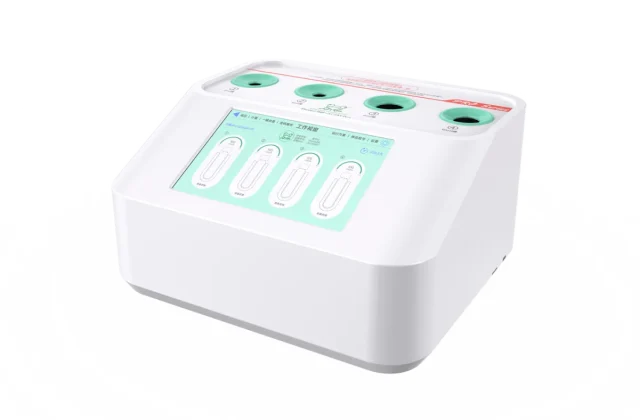
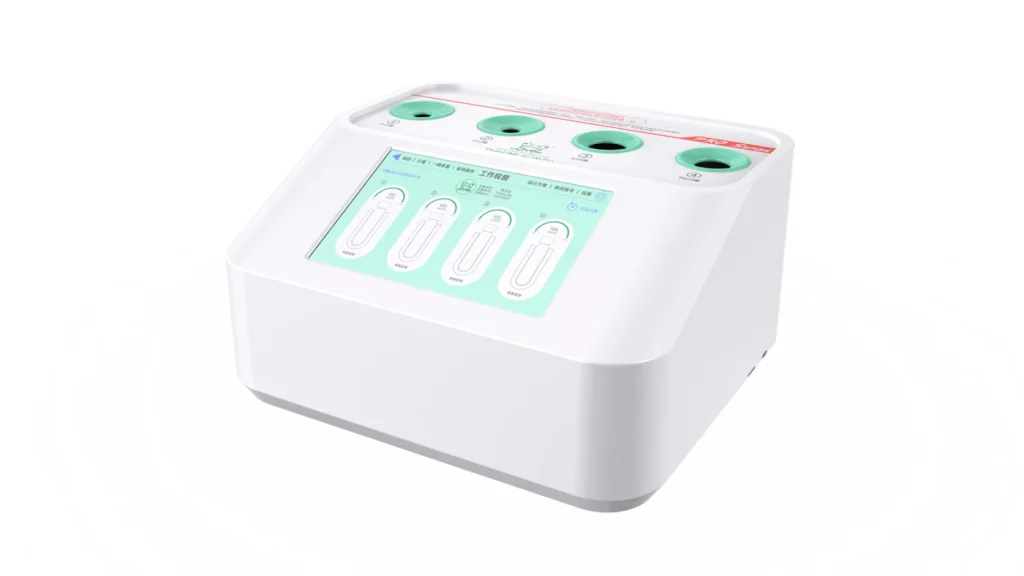
- Location and utilities: bench or cleanroom, ambient temperature, power circuit, adapter rating. The four-channel tube unit draws up to 300 W through a 12 V / 15 A adapter; the compact bag unit is 120 W. Record what the socket actually delivers, not what the label says.
- Documents: manual revision, CE documentation, declaration of conformity, packing list, calibration certificate if one is supplied.
- Configuration baseline: the settings as installed — protection temperature, residual-ice target, language, date/time, account list.
The last item is the one people skip, and the one that makes later change control possible. Without a baseline you cannot show what changed.
OQ: test the refusals, not just the functions
Most OQ protocols test that the unit heats. The informative tests are the ones where it should not start.
| Test | Method | Acceptance criterion |
|---|---|---|
| Channel independence | Run four containers with different targets | Each channel completes on its own target; no cross-talk |
| Temperature guard | Present a sample above the protection setpoint | Run refused, alarm shown, event recorded |
| Residual-ice target | Run a representative container to the configured target | Cycle ends at the target, not at full melt |
| Access control | Attempt a supervisor action as an operator | Action blocked; attempt visible in the log |
| Alarm handling | Trigger an unattended-sample or over-temperature condition | Alarm raised, run state recorded |
| Record output | Complete a run, export and print | Ten-field report matches the run; exported curve is not editable |
| Sanitisation | Run the ozone cycle | Cycle completes in the stated time; log entry created |
Two notes from practice. First, the guard test should be done with a sample at a realistic temperature, not a room-temperature tube waved near the slot. Second, if the unit has three permission tiers, test the tier boundary explicitly — administrators and supervisors behave differently, and the difference is what an auditor will probe.
PQ: the part that usually gets skipped
Performance qualification is where the instrument meets your actual process. Three consecutive runs with the same container type and a representative load is a reasonable minimum for a bench-scale thawer.
What to measure depends on the product, but the usual set is:
- Time to target for each run, and the spread between runs. A unit that finishes in 4, 4 and 9 minutes has a problem that an average hides.
- Viability or recovery on a surrogate, measured by your existing assay. The instrument should not change the result; if it does, the parameter set is wrong.
- Record completeness — every PQ run should be retrievable months later, with operator, time, parameters and outcome.
- Deviation handling — if a run is refused by the guard, that is a data point, not a failure to hide.
Write the acceptance criteria before the first run. "Viability within the historical range for this material" is acceptable if the historical range is documented; "acceptable viability" is not.
The five gaps auditors find most often
- No configuration baseline. Settings were changed after qualification and nobody recorded it.
- OQ without refusals. The happy path was tested; the guard and lockout were not.
- PQ with the wrong container. Qualification used a 2 ml vial, production uses a 50 ml bag.
- Paper-only records. Thermal printouts fade. Keep the digital export as the primary record and treat paper as a copy.
- Sanitisation between samples undocumented. The 30-second ozone cycle is easy to log — and easy to forget to log.
Keeping it proportionate
A bench-scale thawer in a research lab can be qualified with a short IQ and a functional OQ, and requalified after service. A thawer inside a manufacturing record needs the full set plus change control on the stored protocols, because the protocol itself becomes part of the process definition.
The compliance-grade instruments are built for the second case: three permission tiers with password expiry, saved run protocols recalled rather than retyped, SD-card records plus a Bluetooth thermal report, and six alarm classes including a hard refusal when the sample is too warm. That does not replace validation — it makes the validation evidence easier to produce. See the ThawLINE Pro specifications for the parameters that go into the OQ table.
If you are writing the protocol now, the selection guide lists the seven specifications that should appear in it, and the CAR-T thawing protocol shows how the settings map to an actual process. We are happy to review a draft OQ against the instrument’s parameter set — send it through the quote page and we will mark up what is missing.