Dry ice does not fail suddenly. It disappears at a measurable rate, and the shipment fails when the last of it sublimates before arrival. Sizing a shipment is therefore arithmetic, not guesswork — provided you measure the rate for your box instead of borrowing a number from a supplier.
This note covers the measurement, the sizing calculation, and the two placement mistakes that make a temperature trace useless.
What sublimation rate actually means
Dry ice sublimes from solid to gas at about -78.5 °C, skipping the liquid phase. The rate depends on:
- insulation quality of the box;
- surface area exposed to the ambient;
- ambient temperature around the box;
- fill level — a partially filled box has more air to cool and a larger internal surface;
- handling — every opening releases cold gas and admits warm air.
The number that matters is kilograms per day (kg/day) for your box, at your ambient, with your fill level. Two identical boxes in different seasons do not have the same rate.
How to measure it in one day
- Fill the box with a known weight of dry ice, in the pattern you will actually ship.
- Close and mark it, and place it where it will sit during transport (not in a -20 °C room).
- Weigh the whole box at 0, 6, 12 and 24 hours, without opening it longer than necessary.
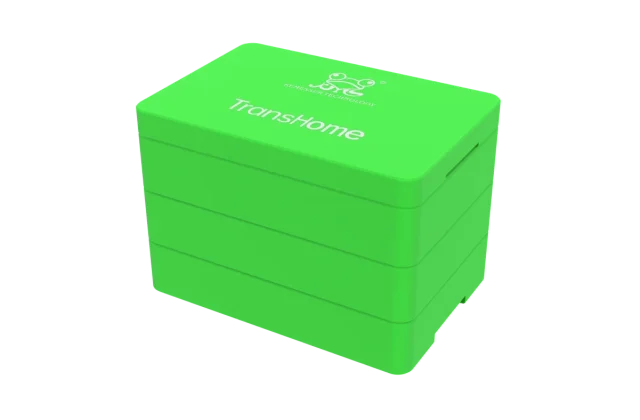
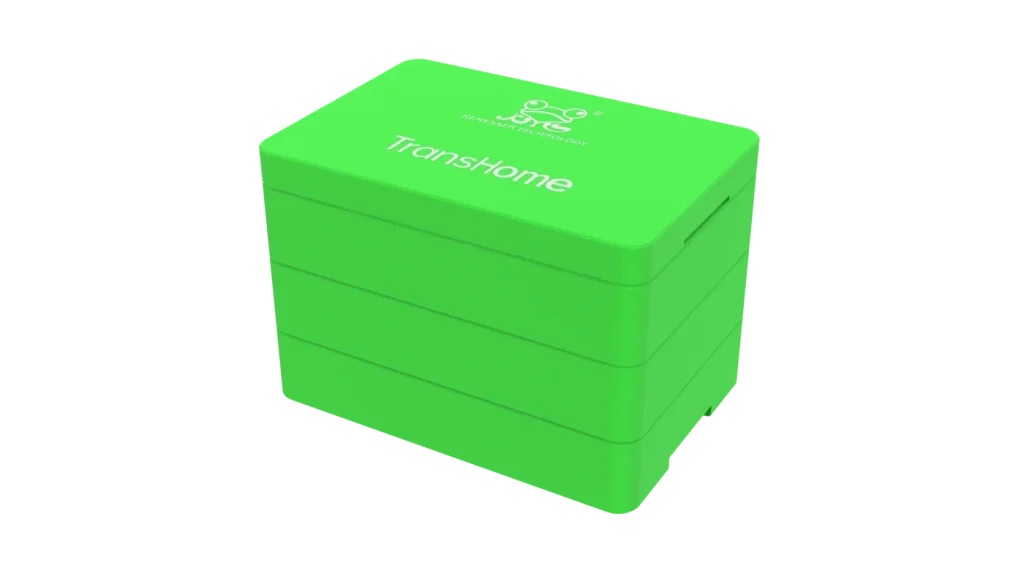
- Subtract the box’s empty weight (4 kg for the 15 L TransHome box).
- Plot the loss. A straight line gives you kg/day; a curve tells you the box is losing insulation or the fill pattern is wrong.
Do this at the ambient temperature you expect. If a route crosses climates, measure the warmest case.
Sizing the load
The calculation is short:
required ice (kg) = rate (kg/day) × transit hours / 24 × safety factorWith a measured rate of, say, 2 kg/day, a 72-hour route needs 6 kg before the safety factor. A factor of 1.3–1.5 is normal for a first shipment, then reduce it once you have arrival data.
Two constraints sit on top of the arithmetic:
- Volume. A 15 L box holds 15 litres of ice, not 15 kg of sample. The inner compartment (330 × 160 × 295 mm inside a 530 × 360 × 365 mm shell) is for samples, separate from the ice space.
- Weight limits. Air waybills and carrier rules limit dry ice per package; check the current DGR for the route rather than the limit from an old SOP.
Fill pattern matters more than total weight
An even layer of ice around the sample compartment holds temperature better than a pile at one end. Two rules:
- Surround, do not cover. Ice around the compartment, not on top of the samples.
- Fill the ice space. Air gaps increase the sublimation rate and create warm pockets near the samples.
If the box can be opened in transit, plan a top-up point. If it cannot, size for the full route plus margin.
Where to put the logger
This is the most common mistake in cold-chain validation: the logger is placed next to the ice and records -70 °C for the whole journey. That trace proves the ice was cold; it says nothing about the samples.
Put the logger in the sample compartment, at the position furthest from the ice, and preferably inside a representative sample holder. If you want two loggers, put one in the sample compartment and one outside the box to record ambient.
Reading the trace afterwards
A useful arrival trace shows three things:
- the sample compartment stayed within the required band for the whole transit;
- there was margin at arrival — not a trace that hits the limit exactly as the box is opened;
- no short excursions during handling, which usually mean the box was opened too long at a transfer point.
If the trace hits the limit at hour 70 of a 72-hour route, the shipment worked but the margin is zero. Increase the ice or reduce the route time before repeating it.
The equipment side
A passive box such as TransHome provides 15 L of dry-ice capacity, a 4 kg empty weight and an inner compartment separated from the ice. It can be topped up in transit, which turns a long route into two shorter legs, and it doubles as mobile -78 °C storage at the bench.
For the declaration side — UN1845, marking, and when UN38.3 applies to battery equipment — the dry-ice shipping note covers the paperwork. For sample-level consequences of a cold-chain excursion, the post-thaw troubleshooting table shows where the damage usually appears first.
A one-page shipment record
Keep these six fields with every shipment:
| Field | Why |
|---|---|
| Ice weight at packing | Baseline for the calculation |
| Packing time | Start of the clock |
| Ambient at packing | Explains a fast or slow sublimation |
| Logger position | Proves the trace is about the sample |
| Arrival time and ice remaining | Validates the rate for next time |
| Sample compartment min/max | The only number that matters to the product |
After three shipments the rate is yours, not an estimate, and the sizing becomes routine.
If you want the box dimensions and ice capacity checked against a specific route and transit time, send us the details and we will work through the sizing with you.
<!– Facts: TransHome 15 L dry ice, outer 530x360x365 mm, inner 330x160x295 mm, 4 kg empty from Cold Operation knowledge base entity page; sublimation arithmetic is general engineering method, no supplier rate is asserted. –>