A vial and a bag hold the same cells, so it is tempting to assume they thaw the same way. They do not. The container sets the volume range, the thermal contact, the run time and — often — the instrument you have to buy.
This is a practical comparison for labs deciding which format to standardise on, and for labs that already use both and want one protocol to cover them.
The numbers first
| Cryovial | Cryobag | |
|---|---|---|
| Typical volume | 1.5–5 ml | 30–450 ml |
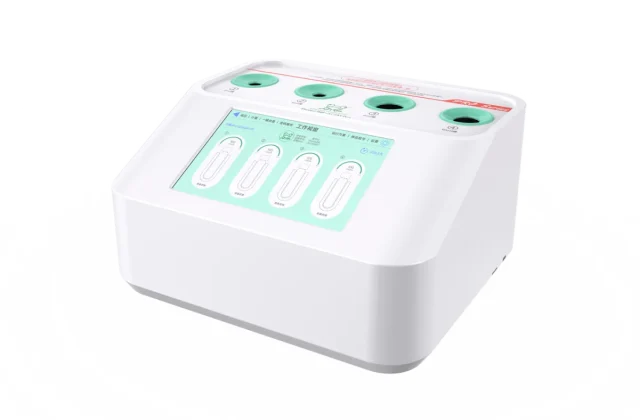
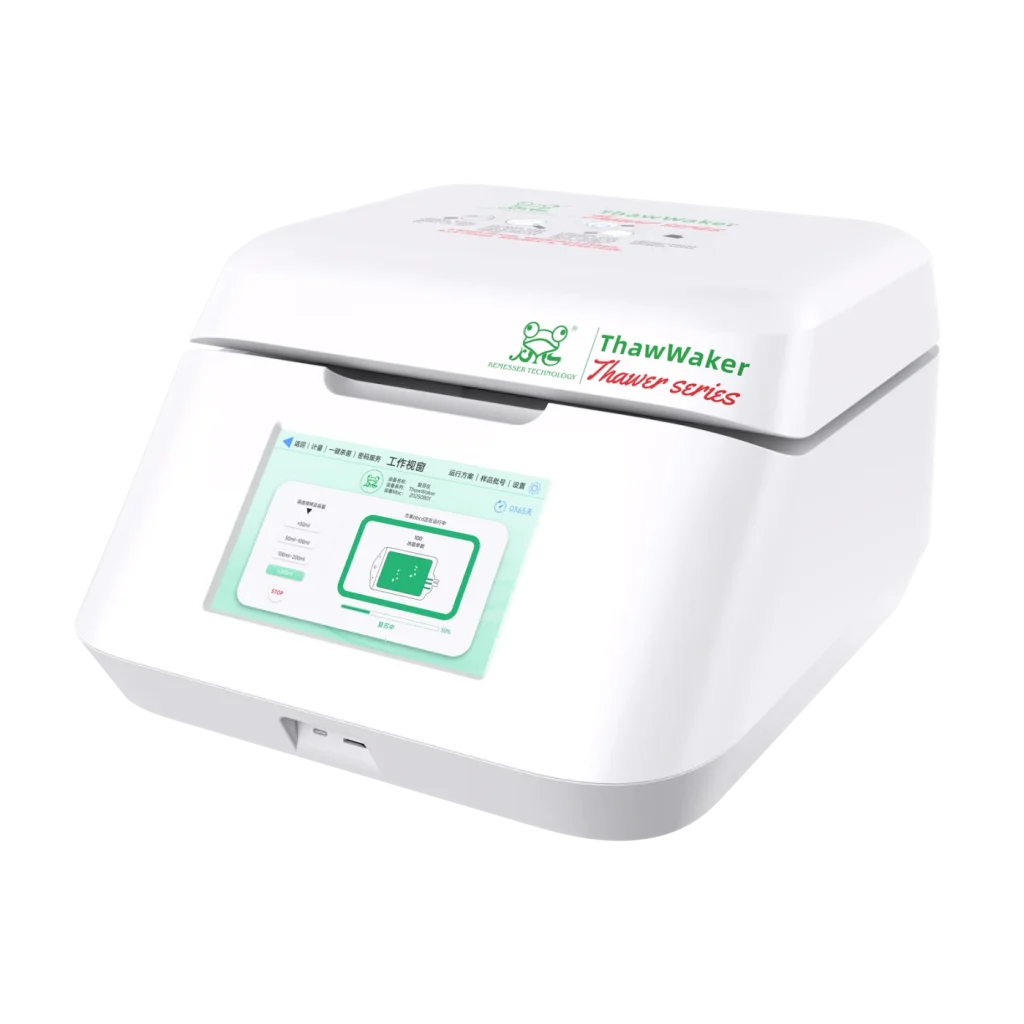
| Instrument example | ThawLINE (1.5–5 ml, 2–8 min) | ThawWaker (30–450 ml, 2–8 min) |
| Slot design | Round slot, contact around the tube wall | Heated lid closing on the bag |
| Cycle time driver | Tube diameter and fill volume | Bag volume and contact pressure |
| Handling after thaw | Transfer to a tube for dilution | Dilute in the bag or transfer to a bag line |
| Downstream fit | Research, small batches | Cell therapy, closed processing |
The overlap is narrower than it looks: a 5 ml vial and a 30 ml bag sit on either side of a gap, and the instrument that handles one does not handle the other.
Heat transfer is the real difference
In a vial, heat enters through a small cylindrical wall. The distance from the wall to the centre is a few millimetres, so the core warms quickly once the outside is above freezing. That is why a 2 ml vial can finish in 2–3 minutes while a 50 ml bag takes 5–8.
In a bag, heat enters through a flat face, and the bag has to be held against the surface. If the contact is uneven — a wrinkle, an air pocket, a bag that does not sit flat — the thin part thaws first and the thick part lags. This is why bag instruments use a heated lid with a flexible structure and multiple probes: the physical problem is contact, not temperature.
The practical test: on a bag instrument, a run that finishes early usually means poor contact, not a fast thaw. On a vial instrument, a run that finishes early usually means the sample was smaller or warmer than assumed.
Records and access control
Container choice often decides the compliance tier, because the two formats are used by different groups:
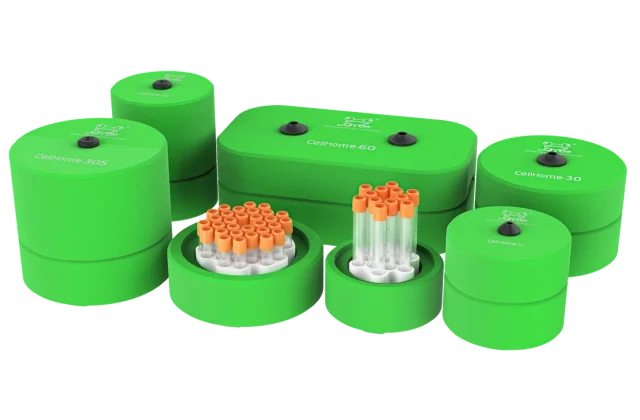
- A research lab thawing vials may only need a dry, repeatable unit with an alarm (ThawHome AB covers 1.5–2.0 ml and 4.0–5.0 ml tubes at ≤2 and ≤3 minutes, with no account structure).
- A therapy workflow thawing bags usually needs the record: three access levels, stored protocols and a printed report (ThawWaker), because the bag is part of a batch record.
That is not a rule about containers; it is a rule about what the container is used for. But in practice the two travel together, and it is worth deciding which one you are buying for before comparing prices.
Where each format wins
Vials win when:
- volumes are small and batch sizes are research-scale;
- samples are archived individually and retrieved one at a time;
- the downstream step is a tube-based assay;
- bench space is limited and a compact unit is enough.
Bags win when:
- the product volume is tens to hundreds of millilitres;
- the process is closed and the bag stays the processing container;
- a single batch record has to cover the thaw;
- several bag sizes are used and the instrument has to adapt (ThawWaker offers ≤50, 50–100, 100–200 and ≥200 ml ranges).
The thaw protocol differs in one important place
The dilution step is where the container changes the SOP.
A vial is diluted in a tube, and the operator controls the drop rate by hand. A bag is diluted through a line or a port, and the rate is set by the tubing and the pump. In both cases the target is the same — bring the cryoprotectant down without an osmotic shock — but the failure modes differ:
- vial: dilution started too late, because the operator was waiting for a second pair of hands;
- bag: dilution too fast, because the line diameter allows a faster flow than the validated rate.
Write the dilution step for the container you actually use, and do not copy the other format’s wording into the SOP.
What to check before choosing
- Volume range you will run in the next two years, not just this quarter.
- Container cost and supply — bags have a shelf life and a minimum order; vials do not.
- Downstream process — if the bag stays closed, thawing in the bag saves a transfer.
- Record requirement — decides whether you need the three-tier instrument at all.
- Bench footprint and power — a bag unit with a heated lid is bigger (400 × 445 × 255 mm on ThawWaker) than a vial unit (323 × 288 × 168 mm on ThawLINE).
If you run both formats, the cleanest arrangement is one instrument per format rather than adapters that "fit" both. An adapter changes the thermal contact, and the validated run time no longer applies.
Where the decision usually lands
For vial-based research work, the thawing series overview shows the range from the compact ThawHome tube unit to the ThawLINE Pro. For bag-based therapy work, the ThawWaker covers the full 30–450 ml range with the record structure.
If you are converting a process from vials to bags — or the other way round — the selection guide lists the seven specifications that change, and the validation note covers what has to be repeated after a container change.
Send us the volumes and the downstream step and we will tell you which format the equipment actually supports, rather than which one the brochure prefers: request a quote.
<!– Facts: ThawLINE 1.5-5 ml / 2-8 min / 323x288x168; ThawWaker 30-450 ml / four ranges / 400x445x255; ThawHome AB 1.5-2.0 and 4.0-5.0 ml / <=2 and <=3 min; ThawLINE Pro three tiers from English brochures and knowledge base entity pages (2026-10-22). –>