title: How an alcohol-free freezing box holds -1 °C/min without isopropanol slug: alcohol-free-freezing-box category: Application Notes tags: cryopreservation, freezing, CellHome, isopropanol, controlled rate excerpt: An alcohol-free freezing container reaches -1 °C/min using an insulating body and a conductive core instead of isopropanol. How it works, where the rate comes from, and the four operating rules that keep it repeatable. description: How an alcohol-free freezing box reaches -1 C/min without isopropanol: insulation plus metal core, capacity options, operating rules and validation. date: 2026-10-22 status: draft
An isopropanol freezing container works because alcohol conducts heat slowly and evenly. It is simple, it is cheap, and it has two chronic problems: the alcohol concentration drifts as it is used, and the container has to be refilled, stored and disposed of.
An alcohol-free box gets to the same place with a different mechanism: an insulating polymer body around a metal core. The rate comes from the geometry and the thermal mass, not from a liquid.
The mechanism, in plain terms
Three things happen inside the box when it goes into a -80 °C freezer:
- The insulating body slows heat loss. The wall is a poor conductor, so the sample does not follow the freezer air temperature down immediately.
- The metal core redistributes heat. The conductive core pulls heat away from the tubes at a controlled rate and evens out differences between positions.
- Micro-convection inside the cavity balances the rest. Air movement between the core and the tube wall smooths the curve.
The result is an average rate of about -1 °C per minute, which is the rate the classic controlled-rate protocol is built around. It is an average, not a setpoint: the curve has a start, a middle and an end, and the box is designed so the middle section sits near -1 °C/min.
Why -1 °C/min matters
Cells survive freezing when water leaves the cell slowly enough to avoid intracellular ice. Too fast, and ice forms inside the cell; too slow, and the cell spends too long in a concentrated solute environment. The -1 °C/min figure is the compromise that most cell types tolerate, which is why it became the default in cell banking.
The visible consequence is crystal size. A controlled rate keeps crystals small and uniform; a poorly controlled rate produces a mix of large and small crystals across the same batch. The troubleshooting table for post-thaw deaths lists freezing rate as one of the ten causes for exactly this reason.
Capacity options
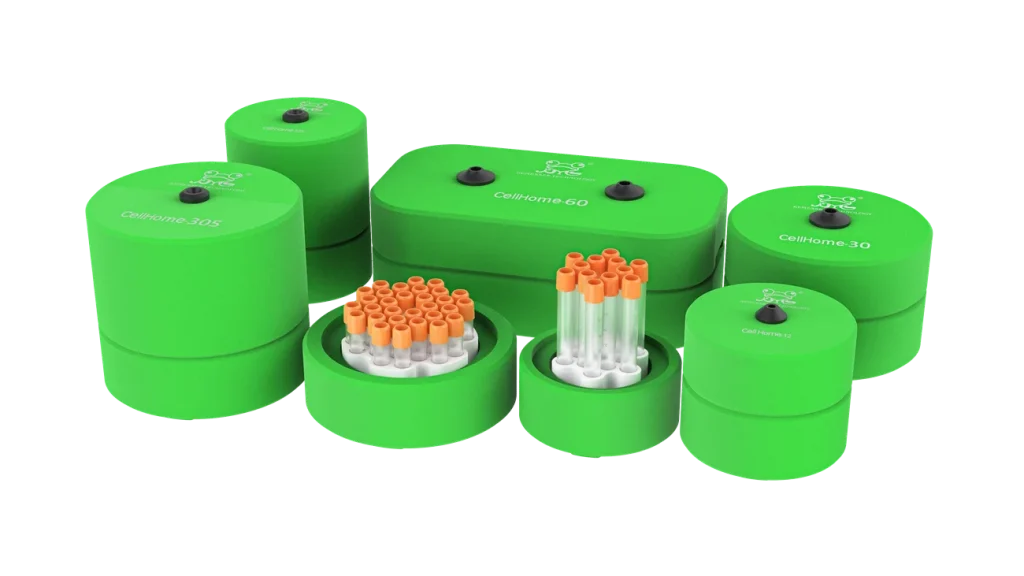
CellHome is available in five formats, which matters because the box has to be filled to work as designed:
| Model | Capacity | Tube type |
|---|---|---|
| CellHome-12 | 12 positions | 1–2 ml |
| CellHome-30 | 30 positions | 1–2 ml |
| CellHome-60 | 60 positions | 1–2 ml |
| CellHome-125 | 12 positions | 5 ml |
| CellHome-305 | 30 positions | 5 ml |
A half-filled box has different thermal mass from a full one, so the rate shifts. If your batch size varies, size the box for the batch you run most often rather than the largest one.
The four operating rules
These are the rules that keep the rate repeatable, and they are the ones that get skipped:
- At least 3 cm clearance around the box inside the freezer. The box needs air circulation on all sides; pressed against a wall or another box, the rate changes.
- Upright, and fully closed. The lid has to be seated; a partly open lid is a different cooling curve.
- At least 3 hours, typically 3–4 hours in the freezer. Removing the box early means the samples have not finished the ramp.
- Validate the rate every 3 months. A thermocouple in a representative tube, one run, compared against the expected curve. This is the only way to know the box is still doing what it did when it was new.
The material range is -96 °C to +60 °C, so the box tolerates the full freezer environment and normal bench handling. It is not autoclaveable.
Cleaning and contamination
- Warm water with a neutral detergent for the tray and lid.
- Surface disinfection with 10% alcohol or a bleach solution.
- No autoclaving, no harsh solvents, no abrasive pads.
- Dry fully before the next use; residual moisture freezes and changes the thermal contact.
Because there is no alcohol, there is no alcohol residue to carry between batches and no flammable liquid to store. That is a real laboratory-safety benefit, not just a marketing line.
Alcohol-free versus isopropanol: the honest comparison
| Dimension | Isopropanol box | Alcohol-free box |
|---|---|---|
| Rate stability | Drifts as alcohol concentration changes with use | Fixed by geometry and thermal mass |
| Consumables | Isopropanol, plus disposal | None |
| Preparation | Fill, check level, top up | None; place and close |
| Consistency across positions | Depends on filling and level | Core evens out position differences |
| Failure mode | Diluted alcohol slows the rate silently | Physical damage or overfilling |
| Safety | Flammable liquid storage | No flammable liquid |
The isopropanol box is not a bad product; it is a cheap one. The alcohol-free box wins on repeatability and on the hidden cost of consumables and disposal, which is the argument in the detailed comparison.
What to check before buying
- Capacity match to your typical batch, not your maximum.
- Tube format — 1–2 ml or 5 ml; the two are not interchangeable.
- Validation method the supplier recommends, and whether a baseline curve is supplied.
- Cleaning instructions in writing, including the disinfectant concentration.
- Freezer clearance in your actual unit.
If you send us your batch size and tube format, we will tell you which model fits and what the expected ramp looks like in a -80 °C freezer: request a quote. For the thawing side of the same workflow, the PBMC thawing protocol covers the other end of the -1 °C/min cycle.
<!– Facts: CellHome five models and capacities, -1 C/min average, -96 to +60 C material range, 3-4 h in freezer, >=3 cm clearance, validate every 3 months, 10% alcohol or bleach cleaning, no autoclaving from CellHome English manual and knowledge base entity page (2026-10-22). –>